WordPress powers roughly 43% of all websites on the internet. That's a staggering number, and there are good reasons for it: it's flexible, there's a plugin for practically everything, and thousands of developers know how to work with it. We're not going to pretend WordPress is rubbish. It isn't.
But there are things about WordPress that most agencies and freelancers don't tell you upfront. And if you're a small business owner deciding between a WordPress site and a custom-built alternative. You deserve the full picture, not a sales pitch from either side.
Where WordPress Genuinely Shines
Let's start with credit where it's due. WordPress is a solid choice when:
- You need a blog-heavy site. WordPress was born as a blogging platform, and it's still excellent at content management. If you're publishing 10+ articles per month and need non-technical staff to manage content daily, WordPress's CMS is hard to beat.
- You want full self-service. If you need to add pages, edit content, and manage your site daily without touching code, WordPress with a page builder gives you that independence.
- You need a large e-commerce catalogue. WooCommerce handles thousands of products with variants, filters, and stock management. For a shop with 500+ products, it's a proven solution.
- You need complex integrations. The plugin ecosystem means there's usually a ready-made solution for connecting to CRMs, booking systems, membership platforms, and payment gateways.
For these use cases, WordPress is a legitimate and sensible choice. No argument from us.
The Problems Nobody Talks About
Plugin Dependency
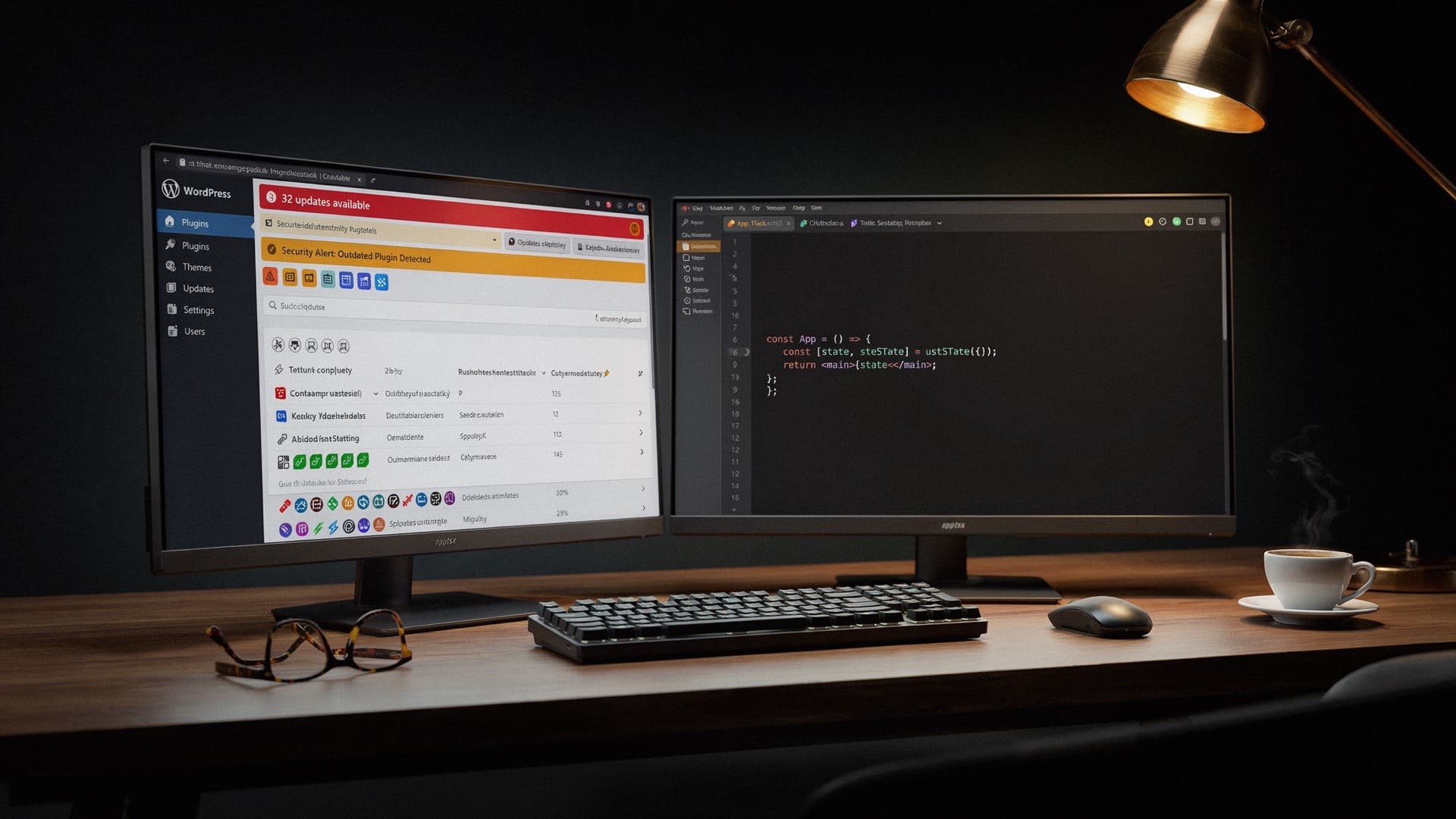
The average WordPress site uses 20–30 plugins. Each one is a piece of third-party code written by someone you've never met, maintained (or not) on their schedule, and potentially conflicting with every other plugin on your site. When a plugin stops being maintained, which happens regularly, you're left with a security hole and a piece of functionality that might break on the next WordPress update.
We've seen businesses with sites built on plugins that no longer exist. The developer who installed them has moved on. Nobody knows what they do. And nobody wants to remove them in case the site breaks. It's a house of cards.
Security: 30,000+ Sites Hacked Every Day
WordPress is the most targeted CMS in the world. That 43% market share is a double-edged sword: hackers target WordPress because the payoff is enormous. Roughly 30,000 WordPress sites are hacked every single day. The vast majority of breaches come through outdated plugins, weak passwords, and unpatched core files.
A custom-built site with no database, no admin panel, and no third-party plugins has an attack surface of essentially zero. There's nothing to hack. No login page to brute force. No plugin vulnerabilities to exploit. No database to inject malicious code into.
Speed Degradation Over Time
A fresh WordPress install is reasonably fast. But then you add a theme. Then a page builder. Then a contact form plugin, an SEO plugin, a caching plugin (to fix the speed problems caused by the other plugins), a security plugin, an analytics plugin, a slider, a gallery, and a cookie consent banner. Each one adds CSS, JavaScript, database queries, and HTTP requests.
The result: the average WordPress site loads in 4.5 seconds. A custom-built site using modern technology (Next.js, static generation, CDN delivery) loads in under 1.5 seconds. That's not a marginal difference. Every additional second of load time costs you approximately 20% of your conversions.
Update Fatigue
WordPress core, your theme, and every plugin need regular updates. Ignore them and you're leaving security holes open. Apply them blindly and you risk breaking your site, because plugin updates frequently conflict with each other or with the current WordPress version. This is why most WordPress agencies charge £500–£1,500 per year for “maintenance”, they're essentially babysitting the update cycle.
A custom site doesn't have this problem. There are no plugins to update. No theme files to patch. No database to maintain. It just works.
Speed Comparison: WordPress vs Custom
| Metric | WordPress (typical) | Custom (Next.js) |
|---|---|---|
| Page load time | 3.5–5+ seconds | <1.5 seconds |
| Unused CSS/JS | 300KB+ loaded on every page | Only what's needed |
| Database queries per page | 50–200+ | 0 (static/pre-rendered) |
| Server response (TTFB) | 800ms–2s | <100ms (CDN edge) |
| Caching complexity | Requires plugin + configuration | Built into architecture |
Speed isn't just about user experience. Google uses Core Web Vitals as a ranking factor. A faster site gets a ranking boost. A slower site gets pushed down. When we built bbqpods.uk. It loaded in under a second, and hit #1 on Google within 8 weeks with zero ongoing SEO spend. Speed and SEO are inseparable.
SEO: Bloat vs Clean Code
WordPress sites rely on plugins like Yoast or Rank Math for SEO. These are decent tools, but they're bolting SEO onto a framework that wasn't built with search engines in mind. You end up with:
- Bloated HTML with unnecessary classes, IDs, and inline styles from the page builder.
- Render-blocking JavaScript from plugins that slow down the initial page load.
- Duplicate or near-duplicate pages generated by categories, tags, author archives, and date archives.
- Schema markup that's generic rather than tailored to your specific business.
- Image optimisation that relies on yet another plugin (and often still doesn't serve modern formats).
Clean code means SEO is built in from the first line: fast, semantic markup, one page per topic, and schema written for the actual business. If you're in Wiltshire and want to know what local SEO should cost and how to check whether it's working, our guide to SEO in Wiltshire walks through it step by step.
A custom site starts clean. Every element is intentional. The HTML is semantic. The schema is written specifically for your business. Images are optimised at build time. There are no unnecessary pages for Google to crawl, no duplicate content issues, and no bloat slowing things down. It's the difference between renovating a cluttered house and building a new one with exactly what you need.
The Real Cost Over 3 Years
This is where the maths gets interesting. Most people compare the upfront build cost and stop there. But websites have ongoing costs, and WordPress has more than most. Here's a realistic 3-year comparison, as we've also outlined in our full UK website pricing guide:
| WordPress (freelancer) | WordPress (agency) | Simple Day (custom) | |
|---|---|---|---|
| Build cost | £2,000–£5,000 | £5,000–£15,000 | £2,500–£15,000 |
| Hosting (annual) | £100–£500 | £200–£600 | £149 |
| Maintenance (annual) | £300–£600 | £500–£1,500 | £500–£1,000 |
| Premium plugins (annual) | £100–£400 | £200–£600 | Custom built, included |
| SEO | Extra: £300–£1,000/mo | Extra: £500–£2,000/mo | Data-led SEO & GEO |
| 3-Year Total | £3,500–£9,500+ | £7,700–£23,100+ | Build fee + hosting & maintenance |
The numbers speak for themselves. WordPress is cheaper to build in some cases, but the ongoing costs, hosting, maintenance, plugins, security, and SEO, add up relentlessly. A custom site from Simple Day is a one-time fixed fee. After that, it's yours. No monthly fees. No annual renewals. No maintenance contracts.
When WordPress Is the Right Choice
We'd genuinely recommend WordPress if:
- You publish large volumes of content regularly (10+ articles per month) and need non-technical staff to manage it independently.
- You need a large e-commerce store with hundreds of products, complex filters, and inventory management.
- You need your team to make daily content changes without developer involvement.
- You have a budget for ongoing maintenance and you've allocated someone to manage updates, security, and plugin compatibility.
When Custom Wins
A custom-built website is the better choice when:
- You're a small business, tradesperson, or service provider with a 5–15 page site.
- Speed and SEO performance are critical to your business.
- You don't want to worry about security patches, plugin updates, or maintenance contracts.
- You want to pay once and own everything, with no recurring costs.
- You want a site that stands out from every other WordPress template in your industry.
- You want a site you actually own and can move anywhere.
Case in point: bbqpods.uk was built with custom code in 12 hours. It hit #1 on Google in 8 weeks with 905 clicks and 7,024 impressions. No WordPress. No plugins. No monthly maintenance. Just clean, fast code with SEO built in.
The Verdict
WordPress isn't bad. It's just not right for everyone, and it's certainly not right for most small businesses that need a fast, secure, SEO-optimised website without the overhead of ongoing maintenance. If your site is 5–15 pages and your goal is to rank on Google and convert visitors into customers, custom is the smarter investment.
Not sure which is right for you? Take our 60-second quiz and we'll give you an honest recommendation. If you run a trade, start with our web design for tradesmen page. In Swindon, see how we build sites that rank, even if your current one is WordPress.
Ready to move on from WordPress?
Answer 5 questions. We build a site that turns visitors into customers while you get on with your day.
Get my quote