“I get all my work through word of mouth.” We hear this from tradespeople every week. And fair play, if you're fully booked with a six-month waiting list, then no. You probably don't need a website. But if you've ever had a quiet month, lost a job to a competitor you know you're better than, or relied on a single referral source that could dry up at any point, then yes. You absolutely need a website. And not just any website. One that actually works.
Let's look at the numbers, the myths, and the real cost of not being online in 2026.
The Word of Mouth Myth
Word of mouth is brilliant. It's free, it's trusted, and it converts better than almost anything else. Nobody's arguing against it. The problem is relying on it as your only source of work.
Here's what actually happens when someone gets a recommendation: “You should call Dave. He did our kitchen and he was brilliant.” What does the person do next? They Google “Dave”. They search for your business name. They look for a website, reviews, photos of your work. 78% of people now Google a tradesperson before hiring them: even after receiving a personal recommendation.
If they find a professional website with photos of your work, testimonials, and an easy way to get in touch, the recommendation is reinforced. They call you. But if they find nothing, or worse, a half-finished Facebook page with posts from 2022, that recommendation starts to weaken. They start looking at your competitors. And your competitor's website looks proper.
Word of mouth gets your name out there. A website closes the deal.
Why a Google Business Profile Isn't Enough
“I've got a Google listing, that's basically a website.” No, it isn't. A Google Business Profile is essential, absolutely have one. But it's limited:
- You can't control the layout, design, or messaging.
- You can't add detailed service pages or project portfolios.
- You compete directly with every other tradesperson in the same listing.
- Google can change the format, ranking algorithm, or features at any time. You have zero control.
- There's no way to add a quiz funnel or convert visitors beyond a basic “call” button.
A Google Business Profile is a signpost. A website is the destination. You need both.
The Problem with Checkatrade, Bark, and MyBuilder
Lead directories are a trap disguised as a shortcut. They promise leads, and they deliver them, but at what cost?
- Checkatrade: Monthly fees from £60–£120+, plus you're listed alongside every other tradesperson doing the same job. The customer picks on price, not quality.
- Bark: Pay per lead, typically £20–£100 depending on the trade. Not per job, per lead. You might pay for 10 leads and book 2 jobs.
- MyBuilder: Similar model. You're bidding against other tradespeople for the same job, driving margins down.
Over a year, a tradesperson spending £100/month on directory listings and £50/lead on Bark (let's say 5 leads per month) is paying £4,200 annually. And the moment you stop paying, the leads stop. You don't own those customers, the platform does.
A properly built website is a one-time fixed investment. You own it forever. And every lead that comes through it is yours, no commission, no per-lead fee, no monthly subscription.
What a Tradesperson's Website Actually Needs
You don't need a 50-page website. You don't need a blog updated weekly. You don't need fancy animations. You need a straightforward site that does five things well:
- 5–7 pages. Home, about/team, services (one page per core service), portfolio/gallery, and contact. That's it. Enough to rank, enough to convert, nothing unnecessary.
- Local SEO built in. Optimised for “[your trade] [your area]” searches. Proper meta titles, descriptions, schema markup, and location signals so Google knows exactly where you work and what you do.
- Click-to-call. On mobile, your phone number should be one tap away from every page. Tradespeople live and die by the phone, make it effortless.
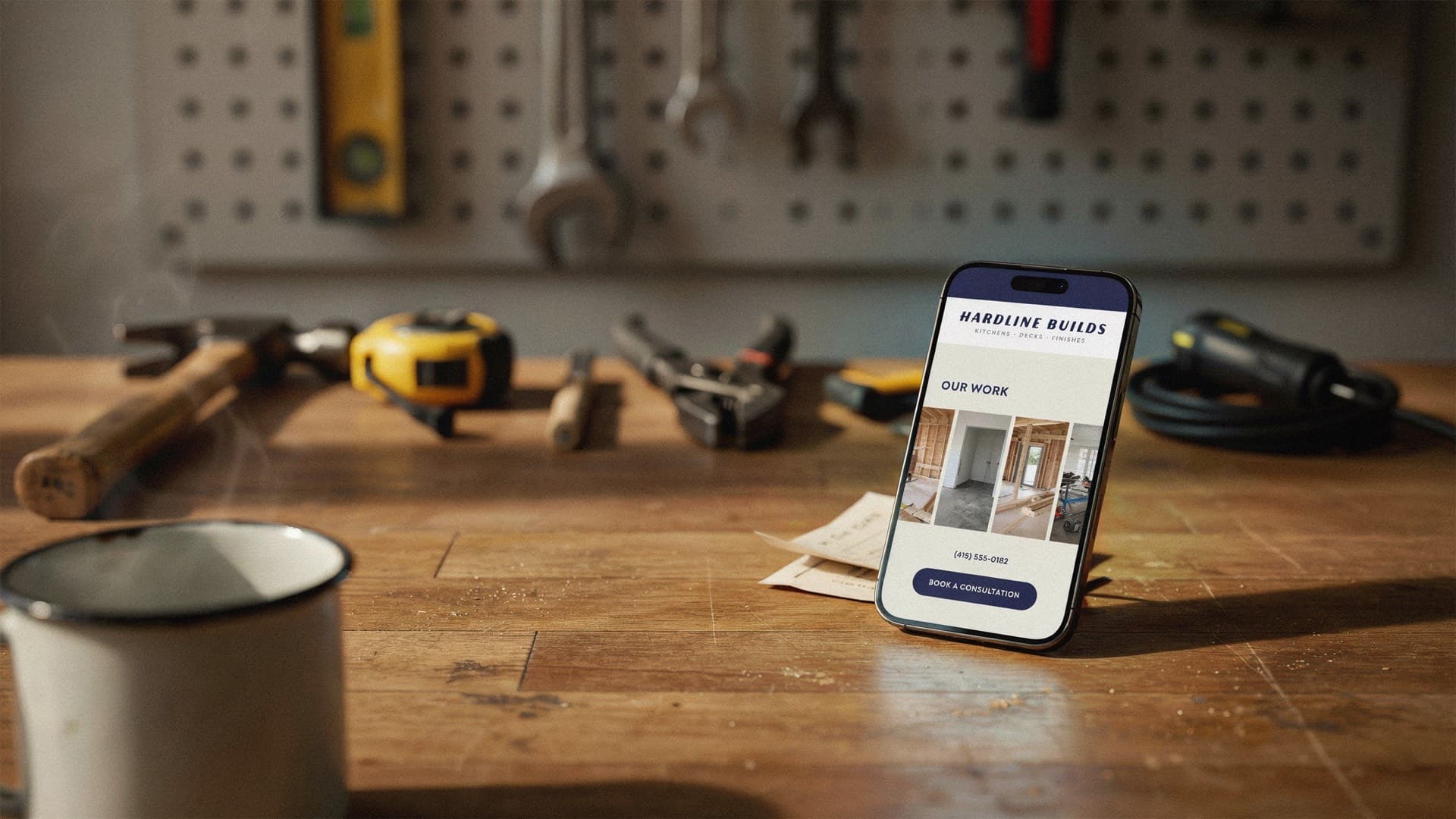
- Portfolio with real photos. Before-and-after photos of your work are more persuasive than any copy we could write. Show the kitchen you fitted, the extension you built, the garden you landscaped.
- Quiz funnel instead of a contact form. “What type of job do you need?” “When do you need it done?” “What's your rough budget?” Pre-qualifies the lead so you're not wasting time on tyre-kickers.
That's the formula. It's not complicated, but it needs to be done properly. A template from Wix won't rank for local searches. A WordPress site loaded with plugins will be slow and vulnerable. A custom-built site with SEO baked in from day one? That works. Check our portfolio to see what this looks like in practice.
The ROI: How Quickly a Website Pays for Itself
Let's do the maths properly. A Simple Day website is a fixed price agreed upfront. Here's how fast that investment typically comes back:
| Trade | Avg Job Value | Jobs to Break Even | Typical Payback Period |
|---|---|---|---|
| Plumber | £500–£2,000 | 2–6 jobs | 1–3 months |
| Electrician | £300–£3,000 | 1–10 jobs | 1–3 months |
| Kitchen fitter | £5,000–£15,000 | 1 job | First month |
| Builder / extensions | £10,000–£50,000+ | 1 job | First month |
| Landscaper | £2,000–£10,000 | 1–2 jobs | 1–2 months |
| Painter & decorator | £500–£3,000 | 1–6 jobs | 1–3 months |
For most trades, a website pays for itself within the first two or three jobs it brings in. After that, every enquiry is pure profit. Compare that to Checkatrade and Bark, where you're paying per lead, forever.
Real Proof: What a Properly Built Website Does
We built bbqpods.uk: a BBQ pod supplier, from nothing but a 15-page supplier PDF. No existing website, no brand, no content.
- Built in 12 hours. Bespoke code, not a template.
- #1 on Google for “bbq pods uk” within 8 weeks.
- 905 clicks and 7,024 impressions from organic search.
- Visitors from 114 countries: all organic, no paid ads.
- Zero ongoing SEO spend. No monthly retainer, no content agency.
That's a product supplier, not a tradesperson. But the principle is identical. Build it properly, bake SEO into the code, and Google does the rest. The same approach works for “plumber Swindon” as it does for “bbq pods uk”.
“Can't I Just Use Facebook/Instagram?”
Social media is great for staying visible to people who already know you. But it has serious limitations as your main online presence:
- You don't own it. Facebook can (and does) change its algorithm, restrict your reach, or shut down business pages. You're building on rented land.
- It doesn't rank on Google. When someone searches “electrician near me”, Facebook pages don't appear in the local results. Websites do.
- It's not professional. A Facebook page with your latest holiday photos mixed in with job photos doesn't inspire confidence in a £10,000 kitchen refit.
- You can't control the experience. No quiz funnel. No structured portfolio. No click-to-call from every page. No SEO.
Use social media alongside your website, not instead of it. Post your work on Instagram, share updates on Facebook, but send everyone back to your website where you control the experience and can actually convert them into enquiries.
How to Get Started
At Simple Day. We build websites specifically for tradespeople and service businesses. See our web design for tradesmen page for the full picture. It's a fixed price agreed upfront, 50% to start, 50% on completion. That includes bespoke code (not WordPress), SEO built in from day one, a quiz funnel, click-to-call, a portfolio gallery, and everything you need to rank on Google and convert visitors into paying customers. No monthly fees. No retainers. You own everything.
If you're in or near Swindon, check out our web design in Swindon page. If you're ready to see what we'd build for your trade, take our 60-second quiz and we'll come back to you with an honest answer.
Your competitors are online. Your customers are searching. The only question is whether they find you, or someone else.